

Artificial intelligence tools are changing the way people search, learn, and work online. Instead of spending hours opening multiple websites and comparing information, users can now get direct answers in seconds. One of the most talked-about tools in this space is Perplexity AI.
Perplexity is more than a chatbot and more interactive than a traditional search engine. It combines AI-generated answers with real-time web information, helping users research topics faster while still seeing the sources behind the answers.
For students, professionals, creators, and everyday internet users, Perplexity offers a practical way to simplify online research without feeling overwhelmed by endless search results.
In this article, we’ll explore what Perplexity is, how it works, its main features, strengths, limitations, and why it has become one of the most useful AI tools available today.
Table of Contents
What Is Perplexity?
Perplexity is an AI-powered knowledge and research tool designed to answer questions conversationally. Unlike traditional search engines that mainly display links, Perplexity provides summarized answers along with references from websites and online sources.
The platform uses advanced language models and web search capabilities to deliver quick, readable responses.
In simple terms, it works like this:
- You ask a question
- The AI searches and analyzes information
- It provides a summarized answer
- Sources are included for verification
This makes the experience feel closer to talking with a research assistant than using a standard search engine.
Why Perplexity Is Different From Traditional Search Engines
Traditional search engines are useful, but they often require users to:
- Open multiple tabs
- Compare information manually
- Filter unreliable content
- Spend time finding direct answers
Perplexity tries to reduce that process.
Key Differences
| Traditional Search | Perplexity |
|---|---|
| Shows lists of links | Gives summarized answers |
| Requires manual research | Combines information automatically |
| Often filled with ads | Cleaner reading experience |
| Limited conversation flow | Allows follow-up questions |
This conversational approach makes research feel more natural, especially for beginners who may not know exactly what to search for.
Main Features of Perplexity
1. Real-Time Web Search
One of the biggest strengths of Perplexity is its ability to pull current information from the web.
Many AI chat tools rely mainly on older training data. Perplexity, however, can access newer information and provide more up-to-date answers.
This is useful for:
- Tech news
- Product comparisons
- Market trends
- Current events
- Software updates
2. Source Citations
Perplexity includes source links alongside its answers.
This feature helps users:
- Verify information
- Explore topics deeper
- Improve trust in the results
- Avoid misinformation
For students and researchers, source transparency is especially important.
3. Follow-Up Conversations
Instead of starting a new search every time, users can continue asking related questions within the same conversation.
For example:
- “What is Perplexity?”
- “How does it compare to ChatGPT?”
- “Is it useful for students?”
The AI remembers the context, making the research process smoother.
4. File and Document Analysis
Perplexity can also analyze uploaded documents and files.
Users can upload:
- PDFs
- Research papers
- Reports
- Notes
The AI can summarize content, answer questions, and explain key ideas from the document.
This saves time when working with long or technical materials.
5. AI-Powered Summaries
Long articles and complicated topics can be difficult to process quickly.
Perplexity helps by generating short summaries that highlight the most important information.
This is useful for:
- Busy professionals
- Students preparing for exams
- Quick learning sessions
- Content research
Practical Use Cases for Perplexity
Research and Learning
Students can use Perplexity to:
- Understand difficult concepts
- Find source-backed explanations
- Summarize research topics
- Explore academic subjects faster
For example, a student researching renewable energy can quickly gather an overview before reading detailed sources.
Content Creation
Bloggers, marketers, and writers often spend hours researching topics.
Perplexity can help by:
- Generating topic summaries
- Finding relevant sources
- Discovering trends
- Comparing products or tools
It works well as a starting point for article planning and idea generation.
Business and Productivity
Professionals use Perplexity for:
- Market research
- Competitor analysis
- Industry updates
- Quick data gathering
Instead of scanning multiple websites manually, they can get a concise overview in minutes.
Everyday Questions
Perplexity is also useful for daily searches such as:
- Travel planning
- Product recommendations
- Tech troubleshooting
- Learning new skills
The conversational interface makes it easier for non-technical users to interact with AI comfortably.
Benefits of Using Perplexity
Faster Information Gathering
Perplexity saves time by summarizing information from different sources into one answer.
Cleaner User Experience
The interface is simple and less cluttered compared to many traditional search engines.
Better Research Workflow
The combination of AI summaries and source citations creates a more efficient research process.
Beginner-Friendly
Users do not need advanced technical skills to use Perplexity effectively.
The platform feels intuitive, even for people who are new to AI tools.
Limitations to Keep in Mind
No AI tool is perfect, and Perplexity also has limitations.
Occasional Inaccuracies
Like other AI systems, Perplexity can sometimes provide incomplete or incorrect information.
Important facts should still be verified from trusted sources.
Limited Deep Expertise
For highly technical or specialized subjects, expert-reviewed sources may still provide more reliable detail.
Dependence on Web Sources
The quality of answers often depends on the quality of available online content.
If the internet sources are weak or outdated, the answer quality may also suffer.
Perplexity vs ChatGPT
ChatGPT
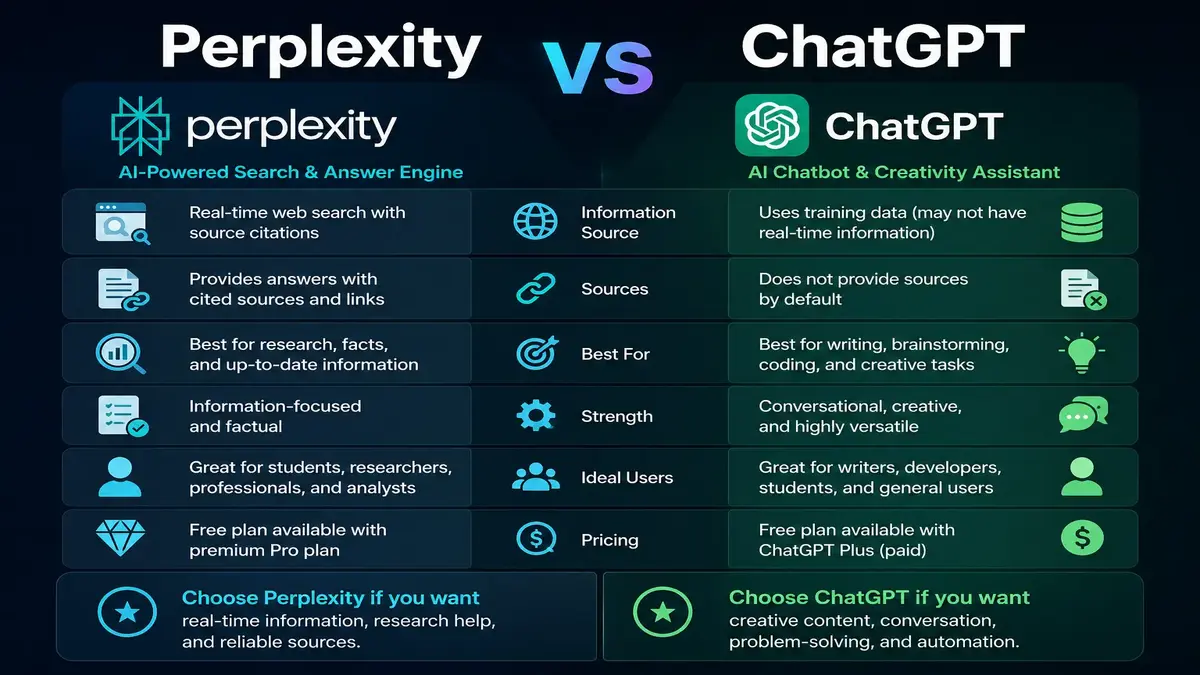
Perplexity and ChatGPT are often compared because both use conversational AI. However, they focus on different strengths.
Perplexity Is Better For:
- Web research
- Source-backed answers
- Real-time information
- Quick summaries
ChatGPT Is Better For:
- Creative writing
- Brainstorming
- Coding support
- Detailed conversations
Some users even combine both tools for better productivity.
Tips for Using Perplexity More Effectively
Ask Specific Questions
Detailed prompts usually produce better answers.
Instead of:
- “Tell me about AI”
Try:
- “What are the best AI productivity tools for students in 2026?”
Check the Sources
Always review linked sources when researching important topics.
Use Follow-Up Questions
Continue the conversation to explore topics deeper instead of restarting searches.
Combine With Other Tools
Perplexity works well alongside:
- Note-taking apps
- Writing tools
- Research software
- Productivity platforms
FAQ About Perplexity
Is Perplexity free to use?
Yes, Perplexity offers a free version with useful core features. There are also premium plans with advanced capabilities.
Is Perplexity better than Google Search?
It depends on the task. Perplexity is excellent for summarized answers and quick research, while traditional search engines are still useful for broader browsing.
Can students use Perplexity for studying?
Yes. Many students use it for research, summaries, and understanding complex topics faster.
Does Perplexity provide accurate information?
It often provides helpful answers, but users should still verify important information through trusted sources.
Can Perplexity replace human research?
Not completely. It works best as a research assistant rather than a full replacement for critical thinking and expert analysis.
Final Thoughts
Perplexity represents an important shift in how people interact with information online. Instead of simply searching for links, users can now have direct conversations with AI systems that summarize and organize knowledge quickly.
Its combination of AI-generated answers, real-time web access, and source transparency makes it one of the most practical research tools available today.
As AI technology continues to improve, tools like Perplexity will likely become more integrated into education, business, and everyday productivity workflows. At the same time, responsible use and fact-checking will remain important.
For beginners and experienced users alike, Perplexity offers a simple and effective way to explore information faster without losing access to the original sources behind the answers.